


Broadening demand base: While we see continuation of gold buying from central bankers who purchased gold in the previous year, the broadening of the demand base could be an emerging theme. Bank Negara Malaysia (3t) made its first net purchase of gold since 2018 while the Bank of Korea looks to resume gold investments for the first time since 2013.
Geopolitical uncertainty remains a persistent backdrop to central bank demand, with January’s high volatility being a notable exception
Notable takeaways
Central banks bought a net 5t in January, as momentum eased at the start of the year – this is compared to a monthly average of 27t in 2025.
Buying was led by Central and East Asian central banks, with Eastern European names also adding to reserves. Notably, Central Asia saw activity on both sides of the ledger — Uzbekistan (9t) among the top buyers while Kazakhstan (1t) was a net seller. Russia was the top seller this month (9t).
The Bulgarian National Bank (BNB) sold 2t of gold in January. The 2t drop from the BNB corresponds to a 2t increase in the ECB gold reserves, as Bulgaria joins the European Union as its 21st member.
Central bank gold buying momentum eased at the start of the year, compared to the prior 12-month average of 27t. Net purchases for the month of January totalled 5t (Chart 1). Volatile gold prices and the holiday season may have given some central banks pause, though geopolitical tensions, which have shown little sign of abating, are likely to keep accumulation going through 2026 and beyond.
Chart 1: Central banks buying momentum intact even as gold prices climb Monthly reported central banks activity, tonnes*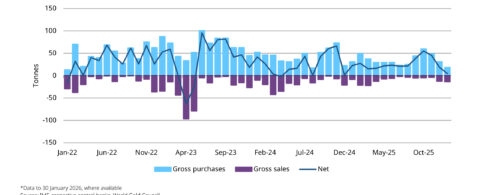
Reported activity in January has been concentrated in:
The Central Bank of Uzbekistan bought 9t the month, continuing its buying streak since October. The purchase lifted its gold reserves to 399t. The growth in Uzbekistan’s gold reserves has been quite precedented, it stood at 57% in the same period in 2020 and grew to 86% of its reserves as of January 2026.1
Bank Negara Malaysia was a new name amongst the gold purchasers, having bought 3t in January – its first increase since 2018. The central bank lifted its gold reserves to 42t, or 5% of its total reserves as of the end of January.
Other central banks that bought gold this month include Czech Republic (2t), Indonesia (2t) China and Serbia at 1t each. China’s 15 consecutive months of gold buying has lifted its gold reserves to nearly 10% of total reserves.
Bank of Russia was the largest net seller this month (9t). This is followed by the Bulgarian National Bank (2t), which transferred the gold to the ECB as part of the country’s euro adoption which took place on 1st January 2026, making it the 21st member of the European Union.2 The Kazakhstan and the Kyrgyz Republic also decreased their gold reserves, each by one tonne.
Chart 2: Central bank gold purchases off to a slower start in 2026 Central bank net purchases and sales, tonnes*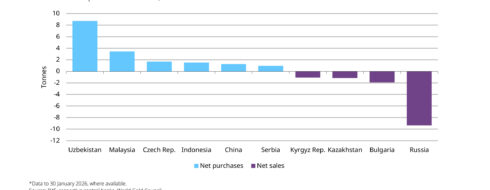
Bank of Korea
The Bank of Korea (BOK) announced plans to incorporate overseas-listed physical gold ETFs into its foreign reserve portfolio from Q1 2026, marking its first gold-related investment since 2013. The BOK cited liquidity and ease of tradability as key advantages of the ETF structure over physical gold. The BOK currently holds 104t of physical gold (roughly 4% of its total reserves), placing it 41st in ranking among global peers. Our Central Bank Gold Reserves Survey 2025 found that accessing gold via ETFs is rather uncommon amongst central banks: none of the respondents whom we surveyed had opted for it as a method to purchase gold.
Conclusion
The broadening of demand from central bankers might be an emerging key theme in 2026. As we have seen in January, both Malaysian and Korean central banks have resumed interest in increasing gold exposure after prolonged absences. The next 10-15 days could prove crucial in shaping the geopolitical backdrop this year, as US-Iran tensions continue to escalate with little indication of diplomatic resolution in sight. The strong pace of gold accumulation by central bankers since 2022 has been intertwined with how nations position themselves in a shifting world order.

