



The first day of the Munich Show & Gemworld Munich 2026 is behind us, Nearly 10,000 visitors came to the five exhibition halls. Crowded aisles, lively professional discussions, and many beaming faces: dealers, scientists, collectors, and goldsmiths from all over the world celebrated the kickoff.
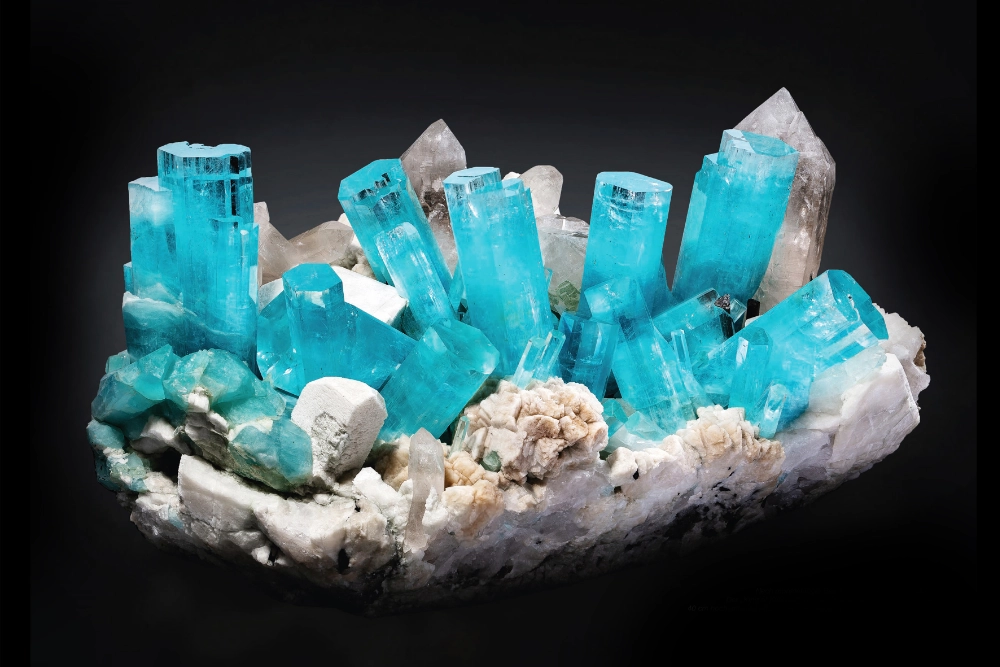 The highlight of the special exhibition “Pioneers & Legends” at the Munich Show is the aquamarine group “King of Kashmir”, which weighs the equivalent of over one million carats. The Gemological Institute of America (GIA) counts this specimen, discovered in 2019 in the Shigar Valley in Pakistan, among the most significant mineral finds of modern times. Yet its extraordinary nature is not solely due to its size. Above all, the perfection of the crystals and their natural arrangement on the host rock make it a unique testament to the immense geological forces at work within our Earth. The “King of Kashmir” is on loan from the Houston Museum of Natural Science, where it was on display for only a short time before being placed in storage due to renovation works.
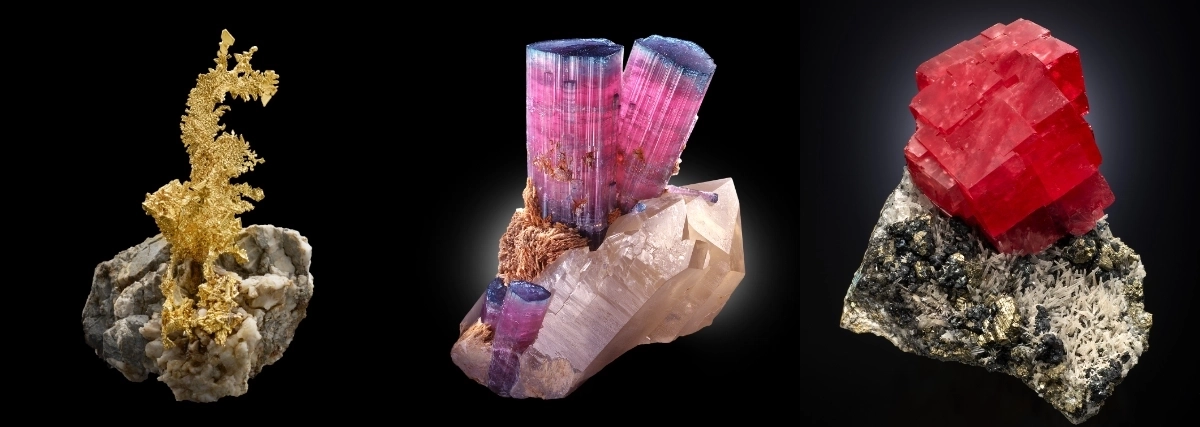
The so-called “Dragon” – the world’s most valuable crystalline gold – is also part of the Munich exhibition. This gold, which remarkably grew naturally in the shape of a ‘Dragon’, hence its name, is one of the most legendary finds from the famous Colorado Quartz Mine in California. Alongside these two treasures, two further legendary natural wonders on display: the “Rabbit Ears”, a perfectly formed and extremely rare red-blue tourmaline, and the “Alma Queen”, a deep-red and nearly flawless rhodochrosite crystal that many experts refer to as the “Mona Lisa” of minerals. This year’s exhibition at Europe’s largest trade fair for minerals, gemstones and jewellery honours the pioneers of the mineral market and showcases their most significant finds.
Unlike diamonds, for which spectacular specimens are regularly found and auctioned, the stones on display in Munich are true wonders of nature. “The probability that such extraordinary crystals can form at all, then survive thousands of years of geological activity and that we ultimately find and able to recover them, is infinitely small. To see four of these once-in-a-century finds in a single exhibition is legendary,” says Alan Hart, former Principal Curator of Gems and Minerals at the Natural History Museum London. Their exceptional rarity lies not solely in their mineralogical composition. Above all, the specific an dunique geological conditions under which individual crystals can grow to such perfection in colour and form over millions of years exist in only very few places on Earth. This is what makes them so valuable to scientists and collectors alike.
 For Christoph Keilmann, Managing Director of the Munich Show, the exhibition is something truly special: “The opportunity to organise a gathering of such exhibits comes once in a lifetime. Being able to show these treasures together to the community, the Munich public and all visitors to the fair is phenomenal, and I am deeply grateful to everyone who has contributed to making it happen.” The Munich Show has been taking place for over 60 years and has previously already presented extraordinary exhibits.
The special exhibition is running from 22 to 25 October at the Munich trade fairgrounds, accessible via the West entrance. Thursday and Friday are trade visitor days; the fair is open to the general public at the weekend.

